
To truly understand an art form, one must first understand what it means to be entirely consumed by it. For a performing artist, true mastery requires total devotion, where the boundary between the creator and the craft slowly begins to dissolve. This profound truth is the beating heart of Sanchara Kala- a magnificent multi-dimensional folk art where singing, dancing, and instrumental music converge into the expression of a single soul.
To sing is one gift; to dance is another. But to become an adept Sanchar performer is to harmonize these disparate disciplines into an undivided whole. The road to mastery is long and steep. Yet for Jayanti Dip, a renowned exponent of this tradition, the grueling training is not merely a sacrifice- it is the very wellspring from which she draws her meaning of life.
Sanchar is an evocative folk tradition deeply rooted in the cultural landscapes of Western Odisha and the adjoining borderlands of Chhattisgarh. It is fundamentally a trimukhi (three-faced) art form carried by the Bahak, the principal performer. Stepping into the sacred performance space, the Bahak undergoes a stunning transformation: they simultaneously play the Mridanga, sing poetic verses, and move in rhythmic grace, all while elucidating complex philosophical or spiritual narratives.
Steeped in antiquity, Sanchara Kala has endured for over 500 years. Its history traces back to the era of Sri Chaitanya, the great mystic who founded the Achintya Bhedabheda philosophical doctrine—a school of thought exploring the simultaneous, inconceivable oneness and difference between the divine creation and the creator. Legend holds that the true architects and founders of this performance tradition were the sages Ramananda and Shyamananda. On stage, the Bahak does not stand alone; they are mirrored and supported by two dedicated assistant performers known as the Gahak or Palia.
The very essence of the craft is anchored in the ancient maxim:
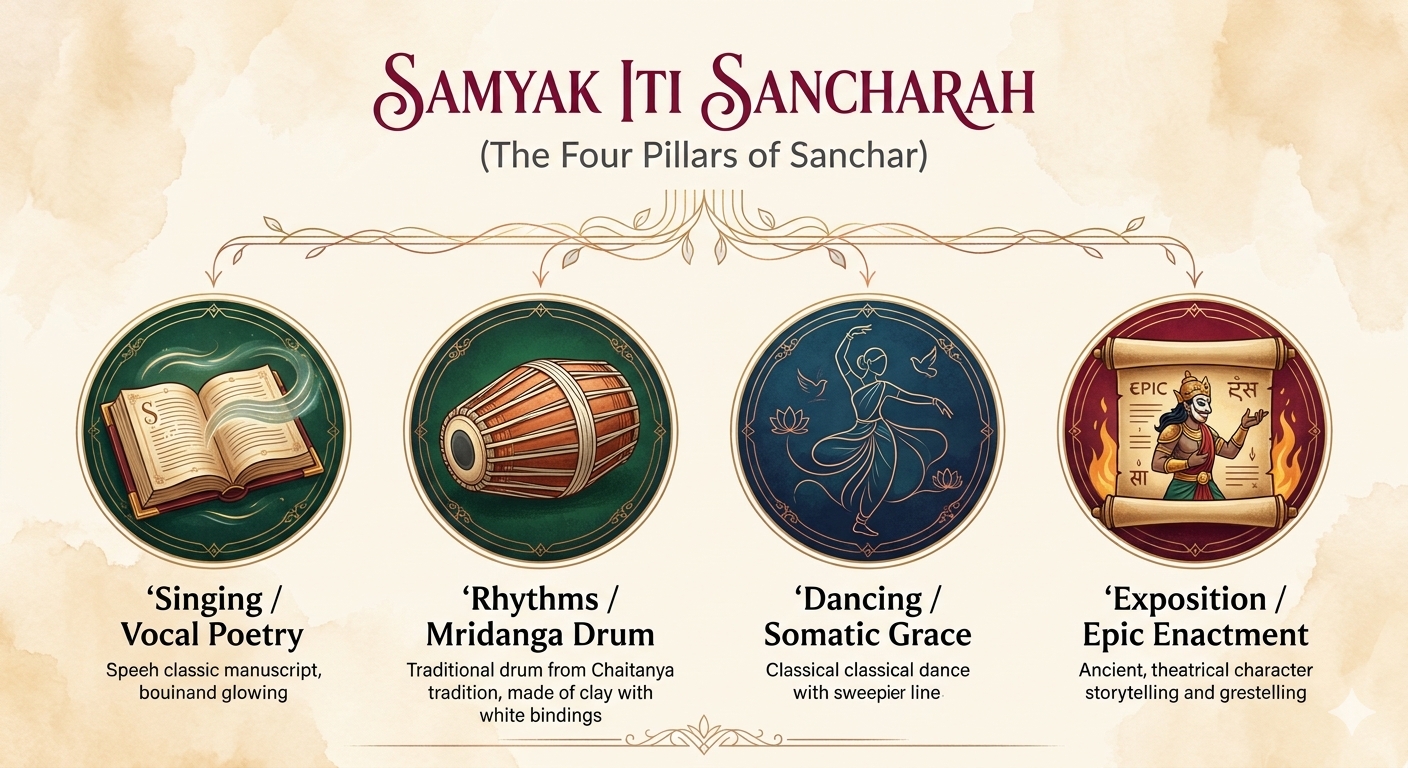
“Samyak iti sancharah” or “Sama yaga Chara”
This underlying philosophy demands the perfect integration of four outward components: singing, playing the instrument, dancing, and dramatic exposition.
The narrative tapestry of Sanchar is woven from the grand epics - the Puranas, the Mahabharata, and the Harivamsam - with the enigmatic figure of Lord Krishna acting as the gravity around which every tale spins.
Yet, the true depth of a Bahak is not measured solely by their ability to retell a story. It is evaluated by their literacy, memory, and capacity to enthrall. To elevate the exposition, the Bahak must fluidly weave in classic verses from legendary Odia poets such as: Upendra Bhanja, Gangadhara Meher and Radhanath Ray, etc.
The beauty and precision of these poetic citations determine the true erudition and standing of the master.
A standard Sanchar performance unfolds over an intensive two hours inside a dedicated sacred boundary called the mandala. The performance follows a rigid, spiritual choreography:
· Entering the Mandala: The Bahak enters the sacred circle carrying the Mridanga, immediately establishing an atmosphere of reverence.
· Honoring the Lineage: Before a single note is struck, deep respect is offered to the performer's personal Guru and the ancient founders of the lineage.
· Awakening the Drum: The performer begins tenderly kneading both leather faces of the Mridanga, preparing the tone of the wood and skin.
· Bowing to the Sound: With a deep bow to Nada Brahma—the omnipresent divine reality manifested as sound—the drumming bursts forth.
As the performance builds, the Bahak guides the audience through a vast spectrum of emotional states (rasas), diving into the depths of Karuna (pathos/compassion), Shanta (tranquility), and Hasya (comic relief), while seamlessly interjecting vital social commentary and ethical lessons for everyday life.
True artistic maturity does not come from the mere accumulation of stories or technical patterns. It requires a quiet mind capable of analyzing how these disparate elements connect to one another. This internal alchemy requires radical patience, mindful repetition, and a complete willingness to question one's own assumptions.
Through this beautiful interpretive lens, Sanchara Kala ceases to be just a folk performance. It reveals itself as a life-long mirror—a continuing dialogue between an individual's aspiration, their discipline, and their expression, through which both the craft and the understanding of the self continuously deepen.
*JB