
We live in an era that is completely intoxicated by information. With a single swipe, we can access the blueprints of distant galaxies, the shifting patterns of global markets, or the collective psychological data of human history. Yet, despite this mountain of data, we often find ourselves drifting- struggling with chronic anxiety, fractured choices, and a hollow sense of purpose.
This is because information tells us what is; knowledge tells us how it works; but wisdom tells us what matters.
Wisdom is not a static collection of facts or an intellectual luxury reserved for ancient sages. It is an active, luminous compass, which is the ultimate currency required to navigate a complex, unpredictable world with grace, resilience, and genuine fulfillment. To understand why wisdom is so vital, we must first separate it from its lesser counterparts: data, information, and knowledge.
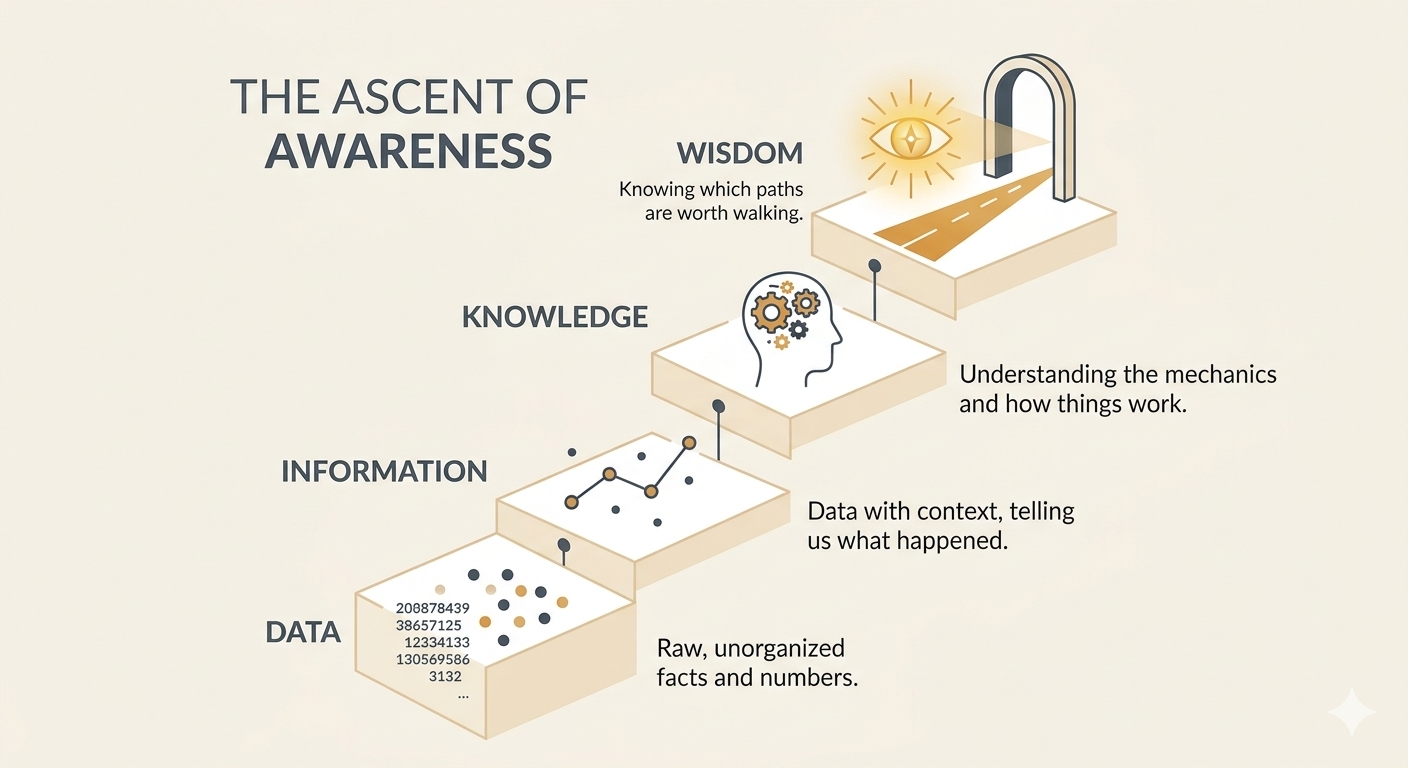
Knowledge equips you with the skill to build a faster engine, compile a flawless portfolio, or construct a brilliant argument. But knowledge is neutral; it doesn't care if the choice you are making aligns with your core values or harms your long-term peace.
Wisdom introduces conscious discernment (Viveka). It takes the lessons of yesterday (Smṛti) and the fresh intuition of the present moment (Pratibhā) to evaluate choices not just by their immediate reward, but by their deep, lingering significance. Knowledge is knowing how to make a living; wisdom is knowing how to make a life.
Without wisdom, the human mind default-adjusts to social expectations, immediate impulses, and unexamined routines. We enter a state of "autopilot living," chasing hollow status titles or collecting physical possessions to fill emotional voids. Wisdom acts as an active, disruptive awareness. It forces you to pause before choices and ask: Is this truly an expression of my authentic self, or am I simply reacting to outside noise? By choosing wisdom over reaction, you dissolve the quiet cognitive dissonance that breeds chronic modern stress, anchoring yourself in deliberate, intentional action.
A major pillar of a wise life is transforming your relationship with the material world. In modern consumption culture, we are trained to constantly chase "more." Wisdom reveals the emptiness of this cycle, introducing the timeless principle of enjoyment through detachment. When you look at possessions, relationships, and achievements through the lens of wisdom, you value them for their true utility and spiritual alignment, rather than using them to feed a fragile ego. You trade the frantic, anxious pursuit of temporary happiness for an unmistakable, deep landscape of meaningfulness.
Life inevitably shatters our comfort zones. When an unexpected crisis strikes- be it a loss, a career shift, or a global disruption- knowledge can fail us because there is no historical blueprint to follow. Here, wisdom provides resilient flexibility. It allows you to balance your history of learning with a raw, spontaneous capacity for fresh reasoning. Instead of freezing in fear when facing the unknown, a wise mind views the unfamiliar as a bridge to expanded awareness, updating its worldview gracefully while fiercely protecting its mental and emotional bandwidth.
Wisdom is never a permanent destination or a static prize to be won; it is the natural, beautiful byproduct of living truthfully. It is the bridge that turns our fleeting days, scattered habits, and abstract ideas into a rich, cohesive landscape of deep significance. By cultivating wisdom, you stop chasing the fleeting ghosts of validation and instead become the sovereign author of your own story, ensuring that even your most mundane, everyday tasks carry a quiet, sacred sense of purpose.
Vedic scriptures view wisdom not as an accumulation of informational data, but as a living state of transcendental consciousness. In the Vedic framework, there is a strict dividing line between Aparā Vidyā (lower, intellectual or material knowledge) and Parā Vidyā (the higher, experiential realization of truth). Ancient literature spanning from the core Samhitās of the Rig Veda to the philosophical depths of the Upanishads and the Bhagavad Gita defines wisdom across three primary pillars.
In the Upanishads, wisdom is identified by the Sanskrit term Prajñā or Prajñāna. This is not analytical calculation, but steady, unshakeable intuition. The Aitareya Upanishad boldly declares one of the grand Mahāvākyas (Great Sayings): Prajñānaṃ Brahma ("Consciousness itself is the Supreme Absolute Reality") Wisdom is seen as the underlying scaffolding of everything that exists. To have Prajñāna is to look past worldly divisions and see the unified field of reality beneath them.
In the Bhagavad Gita, Prince Arjuna explicitly asks Lord Krishna to define a wise person: how do they speak, sit, walk, and handle the chaos of everyday life? Krishna responds by introducing the concept of the Sthitaprajña- one whose wisdom is firmly established.
A person of steady wisdom remains completely undisturbed by shifting circumstances. They do not soar into ecstasy during moments of pleasure, nor do they sink into despair when facing grief. The Gita notes that wisdom is protected when a person can withdraw their senses from harmful, modern distractions at will, comparing it to a tortoise gracefully pulling its limbs into its shell.
Vedic literature commands individuals to actively develop Viveka- the rare intellectual capacity to separate the temporary from the permanent, the helpful from the harmful, and the ego from the true Self (Atman). The Bhagavad Gita honors this state of applied wisdom in verse 4.38: Na hi jñānena sadṛiśhaṁ pavitramiha vidyate. It reminds us that "In this world, there is absolutely nothing as purifying as transcendental knowledge."
Wisdom does not demand that you escape into a forest; instead, it demands that you perform your daily duties passionately while renouncing attachment to the end results (Karma Yoga). By accessing this timeless framework, an individual stops chasing external validation and instead relies on their internal compass, transforming their everyday reality into a deliberate act of mindfulness.
The Upanishads present a radical, deeply transformative view of knowledge, shifting the focus away from external data toward inner realization. In these sacred philosophical texts, knowledge is not something you collect to negotiate with the world; it is the ultimate vehicle for spiritual liberation (Moksha). Rather than viewing the mind as a storage house for information, the Upanishads establish distinct conceptual hierarchies and parameters to define true understanding.
The Mundaka Upanishad (1.1.4) explicitly states that a seeker must understand two different dimensions of knowledge: Aparā Vidyā and Parā Vidyā.
Aparā Vidyā encompasses all book learning, grammar, science, astronomy, and even the literal, analytical study of the scriptures themselves. While necessary to navigate physical reality, it is limited because it deals only with temporary, changing phenomena.
Parā Vidyā is the supreme knowledge through which the Unchanging, Absolute Reality (Brahman) is directly experienced. It cannot be memorized or measured; it must be lived through direct realization of the Self (Atman).
In the Upanishadic lexicon, ignorance (Ajñāna) is not the simple absence of schooling. Rather, it is a structural blindness- the delusion that the temporary body, thoughts, and external items constitute the ultimate reality.
True knowledge (Jñāna) strips away this illusion (Maya). The Isha Upanishad (Verse 11) notes a vital paradox: those who pursue purely material knowledge fall into blindness, but those who balance worldly awareness while anchoring themselves in higher spiritual knowledge can transcend the psychological fear of death. Knowledge is the literal scalpel that cuts away false identification, revealing that your innermost awareness is connected directly to the cosmos.