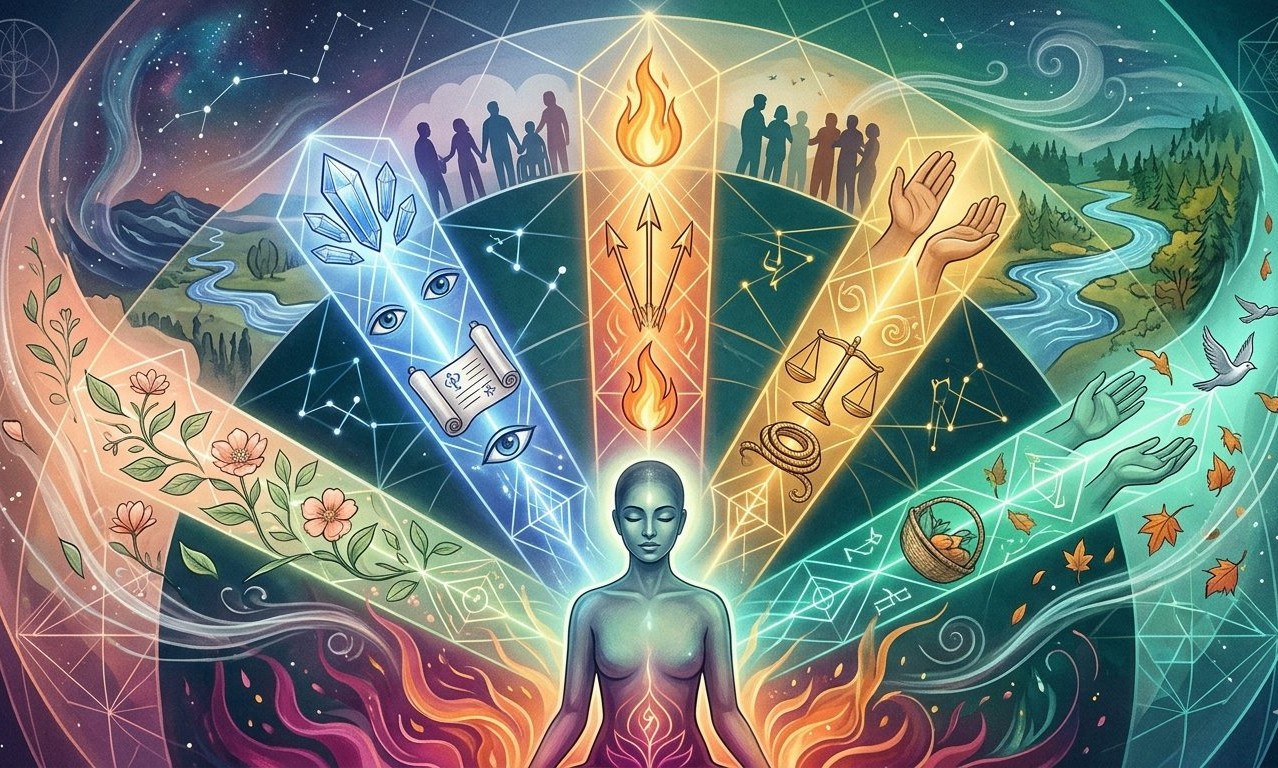

From what unseen depths does the architecture of our mindset arise, and through what mysterious currents do the philosophy and cultural psychology behind it take shape within our being? Our parivesha—the vibrant envelope of our surroundings- and the unique contours of our inner temperament both play their vital roles in this profound phenomenon. Behavioral ecology, casting its gaze upon how human conduct intertwines with parivesha and the intricate tapestry of varied biorhythms- both the internal pulse and the external cycles, inherited through the quiet code of genetic and epigenetic phenomena, as well as the acquired rhythms we patiently develop across the unfolding course of our lives—offers a luminous way of examining this relationship. Yet, a deeper question remains: how do we truly discern the nature of what we are imbibing, and how do we trace the sacred wellsprings from which it originates?
One elegant way of expressing the timeless guidance of ancient Indic wisdom traditions is simply this: connect responsibly with your parivesha, and remain forever responsible to your inner self. Across the sweeping landscape of the Indian subcontinent, indigenous communities continue to sustain customs, sacred traditions, and everyday rituals through which these delicate relationships are expressed in the textures of daily life. Our mindset may first reach us softly, arriving as a story whispered through time, a familiar and comforting practice, or a shared way of participating in harmony with others.
Consider, for a moment, the Saora artists who dwell in the misty highlands. Their spectacular mural paintings, their spontaneously composed songs, and their vibrant, colorful dances reveal a beautiful setting where artistic expression is completely woven into the fabric of community life. The Odisha State Tribal Museum carefully records both their ceremonial idital paintings and their extraordinary, innate ability to compose songs on the spot. Their artistry does not grow in isolation; it flourishes within constant opportunities to observe, to participate, to practice, and to create.
One may naturally ask: what difference could learning about Indigenous communities, or uncovering the deep ethnocultural layers of the traditions into which we are born, truly make to our own modern living? Sifting through the ancient stories preserved across generations reveals what we might call the collective memory architecture of humanity. Within its sacred halls lie profound understandings of belonging, responsibility, humor, loss, nature, and continuity—mysteries that we may seldom pause to examine in the rush of life.
The Saoras, known historically as the Savaras or Sabaras, are woven directly into the ancient epics of the Ramayana and the Mahabharata. Their names echo through the sacred verses of the Bhagavata Purana and the Brahmanda Purana. Within the timeless Jagannath tradition, the legendary Sabara worshipper Viswavasu serves Nila Madhaba, and the contemporary Daitapati servitors proudly trace their heritage back to him. This is a living, breathing sacred tradition that seamlessly connects both the ancient past and the present day.
Here, however, our hearts are concerned with the immediate expression of life as it dances among the Saora. An impromptu song can instantly give voice to romance, to lighthearted humor, and to the fleeting circumstances of an unexpected encounter. Ancestors remain highly significant and deeply revered within traditional Saora religious life, and accounts beautifully describe children receiving ancestral names at birth. An ancestral name carries the soft fragrance of remembrance into a brand-new life, while a newly composed song gives the living present its own unique and resonant voice.
Seen through this poetic lens, coexistence with nature is not an abstract theory, but a living philosophy practiced daily through livelihood, deep relationships, and rich cultural expression. Such enduring practices invite us to consider how communities gracefully sustain their continuity even when standing in the fierce face of change.
Understanding these profound connections can help us recognize the hidden sources of our own active mindset. Intentional living deepens immensely when we pause to examine what we have imbibed from the world, what it truly means within the unique circumstances of our days, and how consciously we wish to carry it forward into tomorrow.
Tracing the sources of our mindset helps us recognize the unspoken philosophy we are already living, as well as the deeper principles we may consciously choose to imbibe for the future. The beautiful Saora example invites us to consider how making intentional room for song, art, humor, and ancestral remembrance can sustain deep meaning even amidst the heaviest hardship. Such an approach offers a highly practicable philosophy of resilience and opens the possibility of antifragility- the rare art of learning, adapting, and developing through the very challenges we encounter along the way. Celebrating life and cultivating creative skills can help preserve an entire way of life while keeping us beautifully attentive to nature and its eternal rhythms.
Present circumstances will inevitably pass, and new uncertainties will surely arise; yet, this need not bring our pursuit of aesthetics to a sudden halt. A stark survival mindset focuses entirely on meeting immediate, pressing demands, while an aesthetics-oriented mindset looks further, considering how we truly wish to experience, savor, and express the gift of life. Understanding the timeless principles behind these inherited practices allows us to draw boundless inspiration from them. Ultimately, intentional living grows through conscious, wakeful participation, as we choose what deserves a sacred place in our lives and cultivate an internal ease through an approach rooted in continuity, yet beautifully open to new, unwritten possibilities.
*SS