Most of us are familiar with the rhythm. We rise, tend to the needs of the body and household, and meet the demands of work, money, family, and community, moving from one Kshetra, one field of life, to the next. Each asks something of us, and we answer as best as we can. Much is handled, and much goes well. And then, in a pause no one scheduled, perhaps as the tea cools or the lights go down, something quietly begins to nag and gnaw: “Is this really me? What am I doing? Is it truly what matters?” Such questions need not signal that something has gone wrong. It may be the first sign that something deeper is ready to be unravelled.
.A day can be carefully arranged and still feel disconnected from the life one wishes to lead. Meals, exercise, work, rest, and recreation may each receive attention, yet their relationships with each other remain unclear. What gives these activities a common direction? It simply helps spearhead our conscious progression towards actualising one’s self.
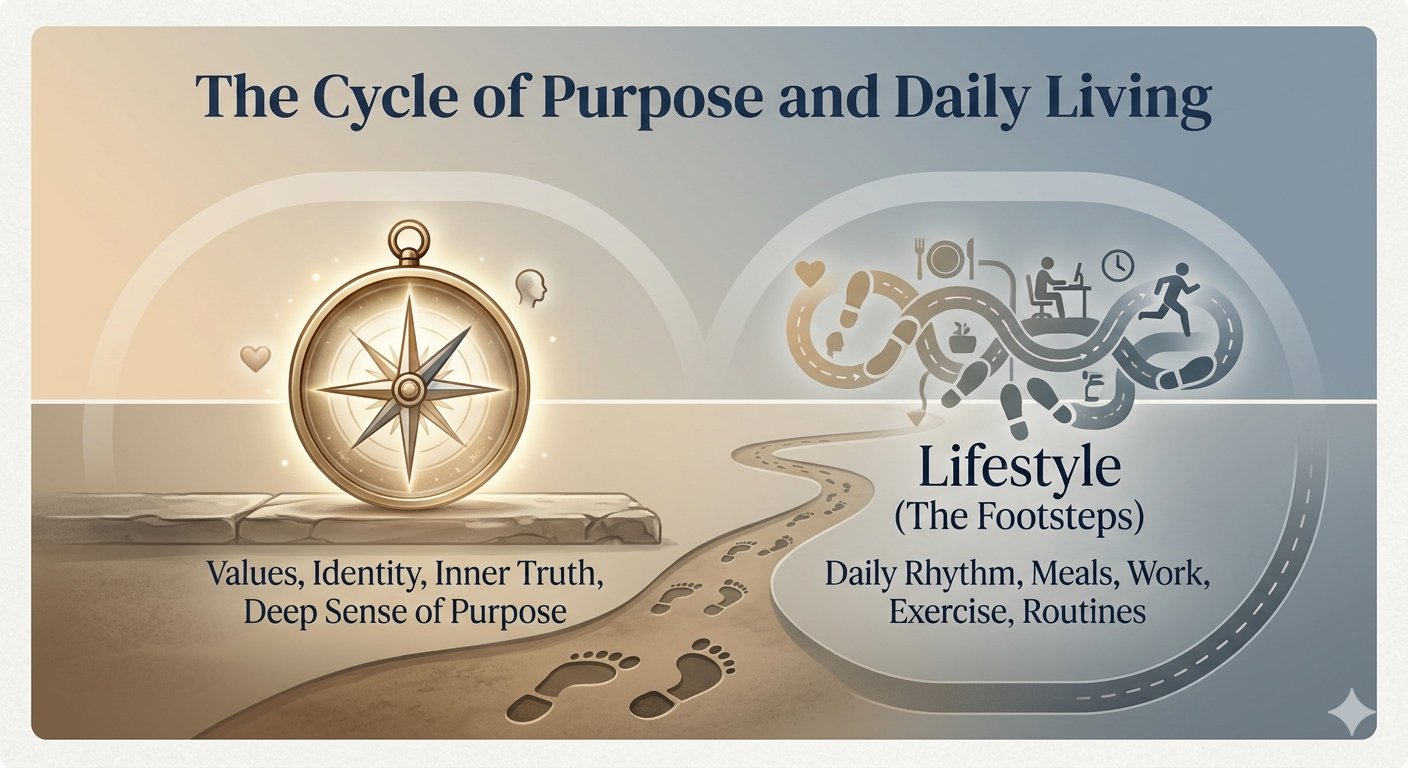
A life stance concerns the values and understandings through which one approaches existence. It influences what one considers worthwhile, the responsibilities one accepts, and how one responds when competing demands arise. Think of it as a quiet compass behind each decision. If the life stance is the compass, lifestyle is the footsteps. Lifestyle gives these orientations a practical expression through everyday patterns of living. A lifestyle can be bereft of life stance, or a life stance can also change one’s lifestyle. This goes both ways beautifully.
Now, imagine this relationship being examined with fresh eyes. When the relationship between the two is examined, familiar choices acquire greater depth. Even the simplest ones begin to unravel and untangle or even become tangled into more confusion. Rest can express respect for one’s capacities. Nourishment can become an act of care. Learning can serve as a continuing enquiry. Relationships can become spaces in which one practices the consideration one claims to value.
Often, a personally meaningful “I intend to do this? I intended to change this” etc. does not automatically lead to a sustainable routine. We forget to factor in the fact that our life course is affected by earlier experiences, reactions (ranging from the knee-jerk type to even more informed variants), disruptions, and expectations. Reactions, irrespective of their range, cannot automatically become responses and be the same as those responding with aliveness and inner harmony. There is a gap between reacting and responding, and that gap is where choice lives. Bringing these into a more coherent understanding helps clarify the ways of approaching life-course integration and how its relevance can fit within the present circumstances, even change our treatment of those circumstances.
Of course, life also has its practical edges of survival, and they deserve honest acknowledgement. But it needs to be seen something more than only survival. We cannot deny that living conditions, work schedules, financial resources, caregiving responsibilities, social support, and access to suitable surroundings influence what one can maintain. However, these are not the only factors. For example, many are obsessed with “the idea of discipline”–disciplined life, following the daily motions, devising ways to reinforce that. But without a life stance, it does not amount to any deep change within our consciousness and expressions. Our state of evolution decides the quality, quantity, depth, and longevity of our response mechanisms. Difficulty in maintaining a routine cannot always be understood as a lack of discipline. Sometimes, the arrangement itself requires more than one circumstance permits. Without the backing of a life stance, many habits could be scattered instead of functioning as per holistic systems.
Intentional living involves attending to both meaning and possibilities. One can examine whether a decision, a chosen routine, or a recurrent pattern of behavioural expression has value, whether it is workable and effective in changing one’s capacity to be a thrilled student of life and living with ease amidst the orderly dance of unimaginable randomness. A life stance can provide direction while remaining open to revision as one’s understanding develops. As that understanding deepens, you may notice your days arranging themselves around what matters, almost without effort.
*(Contextualised and famed from the concepts of two research papers published from the Centre for Neuroethnology and Consciousness Studies)