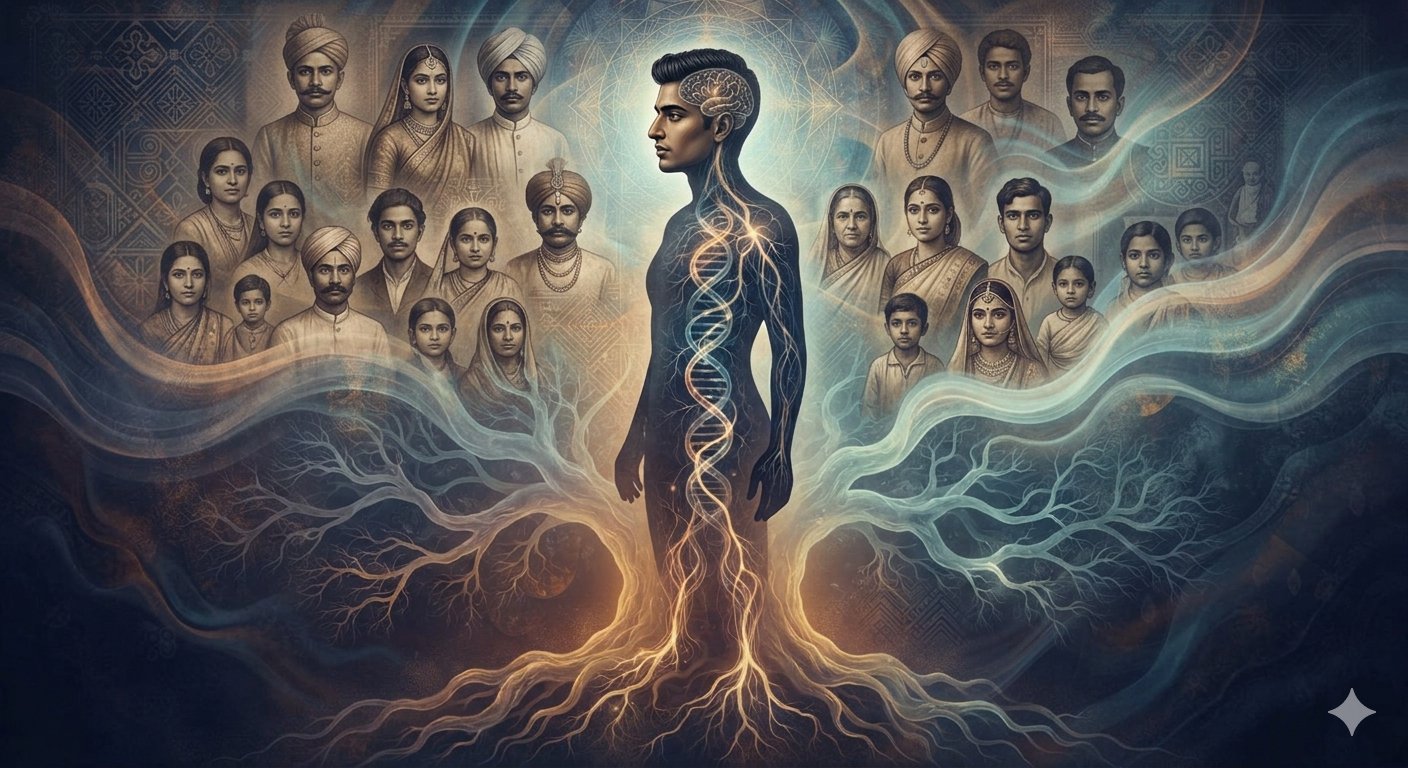
What do we inherit from those who walked the earth before us? Beyond the layered inheritance of generations before us, the echoes of memories, and the rhythms of daily life, we also bear the imprints of experiences that unfolded long before our own stories began. Recognising this inheritance starts with the core foundations of one's family. Its experiences of uncertainty and security, its silences and expressions, and the knowledge that has enabled it to navigate life and reach this point of reflection are truly remarkable.
Transgenerational trauma is about how the impact of really tough experiences can go beyond the people who went through them and affect the next generations too. Things like loss, being uprooted, going without, and feeling unsafe can change how families interact, how they care for each other, their financial situations, and even how they make sense of life. These effects can stick around through how families talk to each other, shared memories, learned behaviours, and the environment in which future generations are raised. It also finds expression and manifests in the individual.
Somatocognitive patternings are the familiar ways in which physical sensations, attention, and memories work together to shape one’s responses. One may notice the shoulders tightening or the breath becoming shallow when anticipating a difficult encounter. These sensations may, in turn, make the situation feel more threatening. A familiar voice, rhythm, or cultural practice may carry a sense of reassurance because of the experiences and relationships associated with it. Over time, such connections can become habitual, arising before one consciously recognises what has prompted them. They develop through the interaction of biological dispositions, lived experiences, relationships, and participation in one’s ethnocultural surroundings. Enquiring into these patterns begins with noticing what happens within the body, what meaning one gives it, and how that meaning influences the next response. This awareness can create room to reconsider a familiar interpretation and gradually develop more flexible ways of responding in everyday life.
Somatocognitive patternings describe how the body’s rhythms and responses connect with one’s perception, understanding, and behaviour. Understanding these patterns helps one recognise how familiar ways of responding take shape and how they may gradually change through everyday life.
“Wellspring epigenetics” is the foundation as well as one of the most fundamental lenses for enquiring into the biological and quite a few other dimensions of this inheritance alongside its familial and ethnocultural continuities. Epigenetic processes are being investigated in relation to adversity and intergenerational effects, but they prefer to be quiet about somatocognitive patternings that one can trace to own inheritance layers. That is where cultral moorings quietly step in.
One may argue that any inheritance can be influential without becoming destiny. However, the inheritance from those who walked the earth before us, connected with the subtle laws of nature and energy, can only be understood by embodiment. These are soft/subtle technologies that continue to influence the preservation of embedded knowledge kernels within the cultural and deeper ethnocultural layers. One needs to recognise this inheritance through the fundamental moorings of one’s own family and then seek pathways that render one confident and competent enough to face life with readiness and ease. Understanding a recurring fear, expectation or patterns in life involves the relationships and conditions that sustain it, alongside the resources through which a different response may become possible.
Within the ethnocultural layer lie embedded practices, meanings, and ways of attending to life that deserve to be understood. Enquiring into how these are learned and embodied can reveal possibilities for better somatocognitive functioning in daily life. Their value becomes personal through attentive participation–by noticing what experiences are evoked, examining the soft influences on one’s responses, and experiencing for oneself whether it supports a more considered engagement with one’s surroundings.
Through this perspective, one may move closer to the synergy of life with which our ancestral wisdom lineages sought and learned to tune themselves with, as well as their legacy wisdom on life, continuing enquiry and refinement as a movement towards their “nextness” and other possibilities through observation, participation and learning.
Bodily experience can become an embodiment of inherited knowledge, as it is learned, practised, and expressed. Ethnocultural roots provide important anchors from which self-reflexivity can grow. One can examine what is truly meaningful and requires reconsideration. Through this enquiry, one begins to participate more consciously in one’s own behavioural ecology, attending to the relationships between physical states, surroundings, and characteristic ways of responding.
Such participation can add more “in-ness” to living life. Herein, “in-ness” is a more attentive presence within one’s inner relation to reality and subsequent experiences, relationships, and responsibilities. This paves the way for intentional living and, in turn, deep healing. Here, deep healing concerns growing coherence in how one inhabits life, acknowledges inherited wounds, draws upon sustaining knowledge, and develops the readiness to meet what comes next.
*(Framed from the concepts discussed in three research papers)