
Our senses possess a quiet, remarkable wisdom; they perceive the world long before our intellect can find the words to map it. Among them, the olfactory sense acts as an unseen messenger, catching the invisible shifts in our environment well before our eyes have fully oriented themselves. It holds the note of a pristine fragrance or a pungent warning with equal, unbiased clarity. Consider the sharp, unexpected scent of a leaking gas cylinder—that sudden shock of realization striking our consciousness, reminding us of the modern fields we manage and the immediate alertness required to secure our surroundings.
A single scent possesses the unique power to drop us through time. Be it a refined perfume, the raw, damp smell of dense forest moss, or the rich, comforting vapor of our favorite dishes simmering on a stove, aroma bridges the gap between the conscious mind and the vast subconscious ocean. When we experience gandha (fragrance), our mind immediately builds a corresponding form, instigating an instinctive search for its source. It triggers a profound undercurrent of attention, drawing us sharply into the living present. Long before an entry is rationalized or a sentence is spoken, a fragrance has already announced its presence, quietly shifting the atmosphere. Gandha, as old as the fertile earth itself, draws us into a wordless dialogue with life. To live a truly holistic existence is to master this subtle exchange: understanding what we actively imbibe from the world, how it leaves its impression within our bodies, and the distinct, intangible fragrance of our own presence that we leave behind when we step away.
Gandha, as an essential sensory building block, long predates the dawn of humanity. It is woven deeply into the primordial mosaic of the earth’s life-bearing history. Indian wisdom traditions map this sensory exchange through Prithvi Tattwa - the Earth Principle - identifying the sense of smell as the foundational anchor connecting our internal system to the physical planet. From basic single-celled organisms to complex mammals, all living beings respond seamlessly to the chemical qualities of their immediate environments.
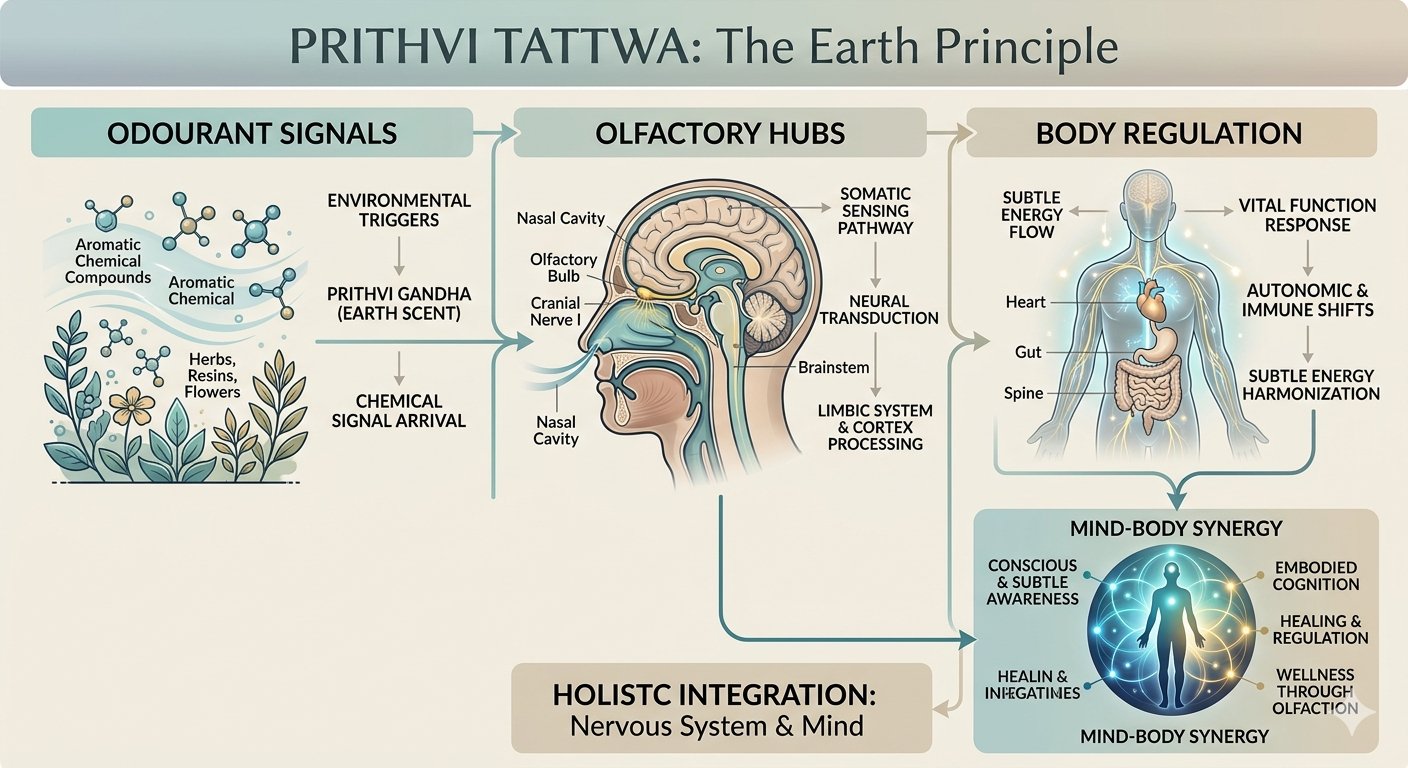
Modern science classifies the molecules that trigger these sensory responses as odourants. Over millennia, biological evolution has refined diverse, intricate receptors to identify them. In more advanced organisms, specialized olfactory pathways instantly transform these chemical encounters into biological electrical signals processed by the deep nervous system. Yet, even baseline organisms completely devoid of a formal brain or nervous structures consistently shift, turn, and respond to the chemical currents around them. This ancient, continuous capacity to sense and align establishes an unbreakable lifeline between the living being and the environment it depends upon for survival.
Within the framework of Indian philosophical and indigenous healing arts, gandha expands far beyond basic physical detection. Its deep connection to the Prithvi Tattwa reaches into the management of subtle energy fields, natural healing, self-regulation, and the delicate aesthetics of daily living. These classic, time-tested interpretations invite us to look at fragrance not as a fleeting luxury, but as a primary, vital bridge uniting our internal bodily systems with the outer world.
Olfactory signals constantly direct human behaviors and social expressions, filtering into our communication and the energy of shared environments without ever rising to the level of conscious analysis. Our unique personal preferences in scent become closely intertwined with our identity and self-expression, while shared aromatic styles help define the invisible boundaries of distinct groups.
The scents we instinctively love frequently carry the physical memory of the exact environments, traditions, and everyday habits with which we have grown intimate. Because chemical sensing is nature's most ancient survival mechanism, it anchors human cognition in a beautiful truth: a profound encounter is often felt, understood, and integrated by the body long before it is translated into human speech.
Indigenous healing systems pay meticulous attention to the subtle grades of natural botanicals and fragrances. Each distinct scent profile is paired with specific mental states and energetic attributes, providing unique pathways to ground the mind and access deeper layers of the self. Aromatic essential oils extracted carefully from living leaves, delicate petals, roots, wood bark, thick resins, raw seeds, and ripe fruits form a core part of holistic living. Their natural aromas systematically shift how we feel and perceive a setting, though their specific benefits naturally vary according to the clean quality of the substance, the unique makeup of the individual, and the setting in which it is introduced.
Consequently, the fragrance we cultivate, the smells we expose ourselves to, and the aromatic footprint we carry through life deserve deep mindfulness. Whether we are deeply focused on our work, relaxing in leisure, resting within our home, or gathering in social groups, fragrance defines the subtle climate of every human encounter. Its impact on how others perceive and experience our true presence is far more profound than we commonly notice.
This sacred significance is vividly preserved across classical Vedic literature. In the Rig Veda (7.59), the timeless Maha Mrityunjaya Mantra rendered by Rishi Vashistha Maitravaruni explicitly exalts the attribute of Sugandh (fragrance), weaving this quality directly into the archetype of Rudra- the supreme master of healers and rejuvenation.
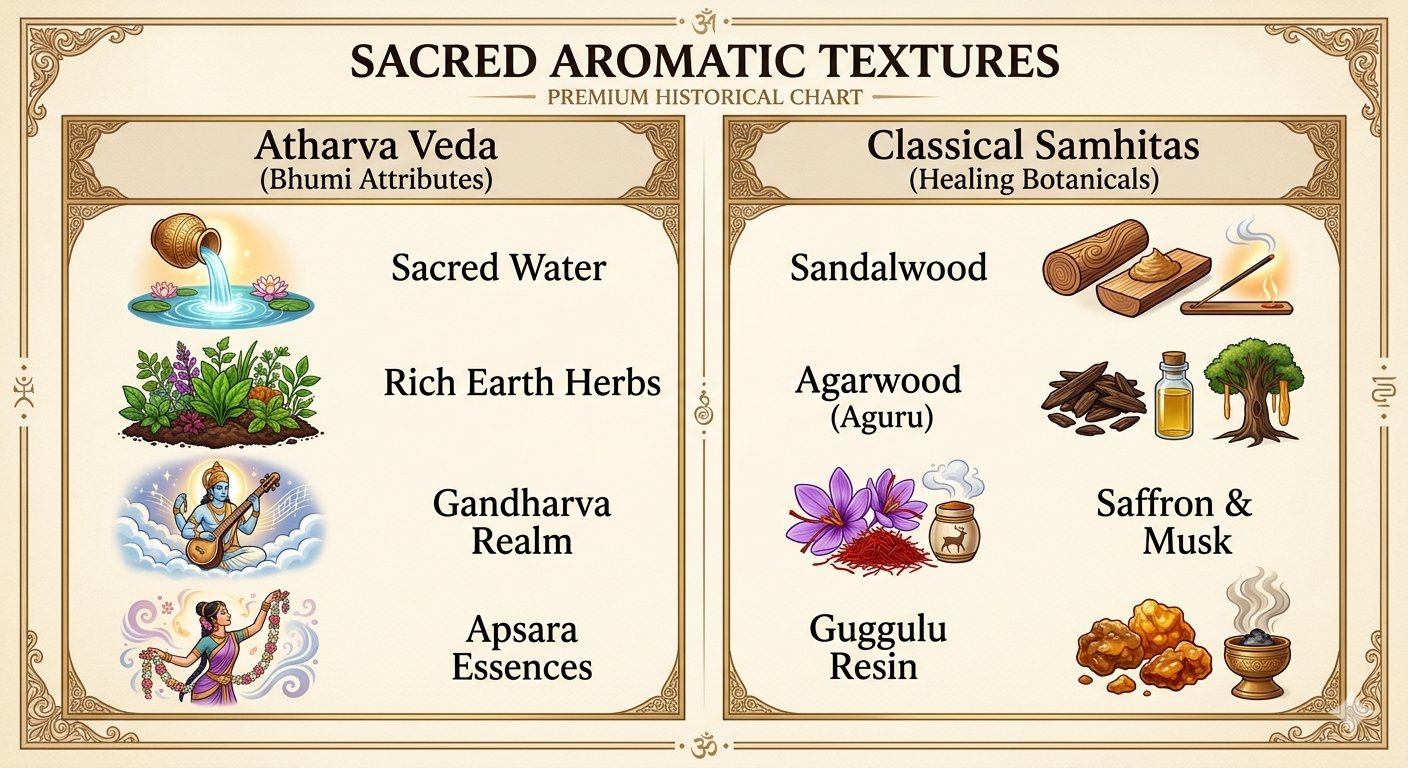
Similarly, gandha stands proudly among the core attributes of Bhumi (the Earth Goddess) in the revered Bhumi Sukta of the Atharva Veda (12.1.23–25). Here, the raw fragrance of the living soil is carried gracefully through its fresh herbs and running waters, shared intimately by the ethereal Gandharvas and Apsaras. In this grand Vedic vision, fragrance represents the absolute continuity between the earth's biological abundance and our active participation within it.
Furthermore, the classical medical compilations of the Charaka Samhita and Sushruta Samhita detail the therapeutic application of precious natural perfumes, including:
Chandana (Sandalwood): To cool the body and instill deep mental serenity.
Agarwood (Aguru) & Guggulu: Rich, grounding resins used to clarify physical spaces.
Saffron, Musk, and Champaka: Fragrant botanicals used to balance the nervoussystem.
Spices (Clove, Dalchini, Javaadi): Warming elements used to ignite internal vitality.
Across these sensory, philosophical, and ethnocultural dimensions, gandha offers a beautiful invitation. It asks us to look more closely at how we internalize our surroundings and how our own physical presence shapes the reality of those we pass by—binding scent into the lived, embodied wisdom required for true, holistic living.
*PM