A single musical note resounding somewhere nearby finds an immediate, responsive movement within us. When human breath meets the discipline of rhythm, deep internal feelings express themselves as melody. Long after the audible sound fades back into silence, this subtle energetic impression lingers.
Through music, one routinely encounters deep dimensions of being that spoken words seldom reach—realms of consciousness we rarely pause to analyze. This is the foundation of Raga Chikischa, the targeted therapeutic use of traditional Indian classical ragas to evoke specific bhavas (emotional states), cultivating inner harmony and a highly attentive experience of one’s own being.
The Science of Sound Healing
Music acts as a profound healer. Modern research across music psychology, musicology, and human physiology establishes that deliberate engagement with music can provide substantial stress relief. It supports key aspects of learning and memory, decreases anxiety, and acts as a complementary intervention for clinical depression alongside various other physical and mental health conditions. Crucially, these therapeutic benefits vary depending on the unique makeup of the individual, the specific music selected, and the environmental context of its use.
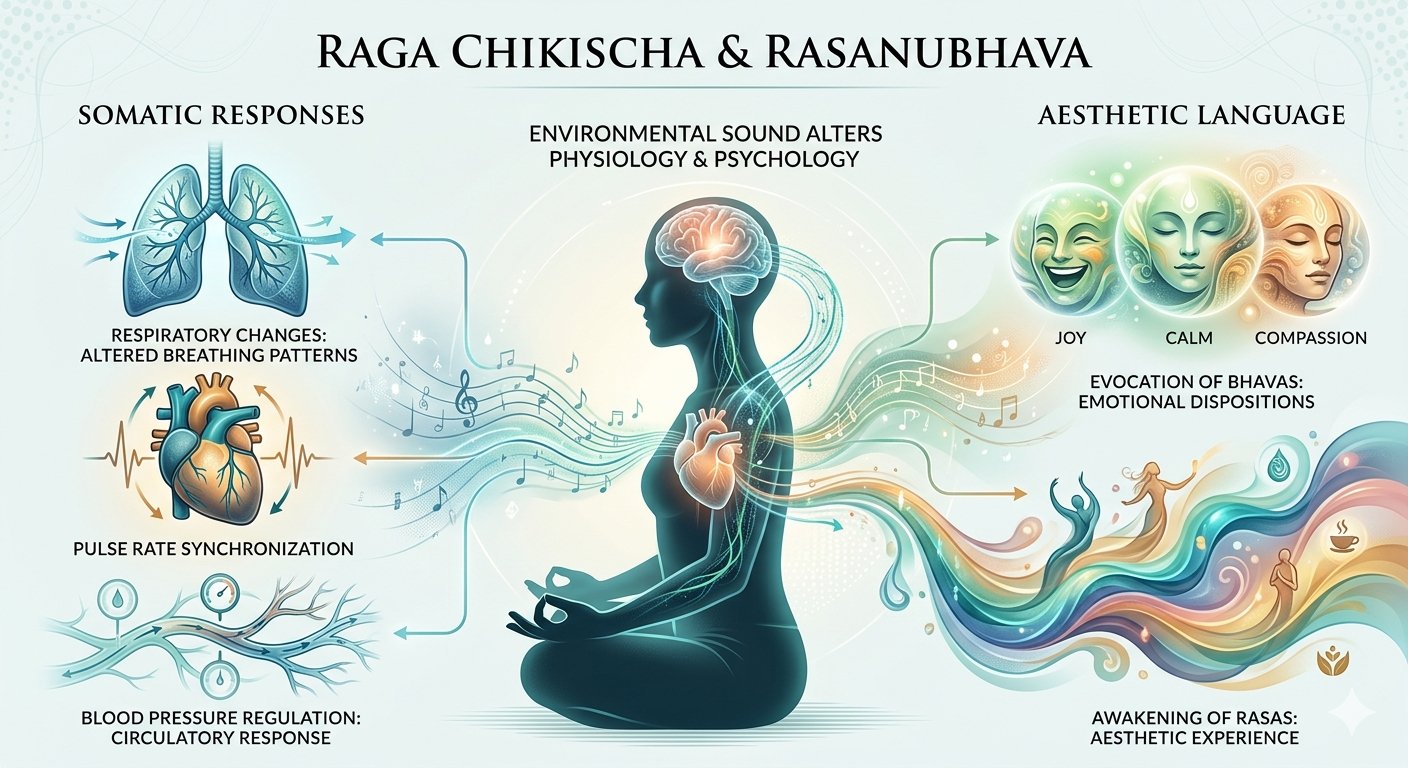
Every person is profoundly altered by the sounds emanating from their environment. Music directly engages both physiological responses and mental states, generating layers of feeling that can be decoded through the aesthetic lens of rasas (tastes/flavors) and bhavas (emotional states). This experiential encounter frequently leaves an enduring impression, occasionally culminating in a sense of genuine transcendence.
As sound vibrations map patterns of structural resonance within a room, the listening experience initiates quantifiable alterations in breathing, muscular tension, pulse rate, blood pressure, and other underlying biological rhythms. Through this physical connection, the atmosphere of a physical space becomes entirely transformed. The resulting emotional release offers an internal cleansing, creating entirely new mental landscapes through which one can formulate meaning in life.
The structured mapping of traditional Indian music, the seven basic notes (swaras), and the intricate relationships governing music, bhava, and rasa find their earliest systemization in Bharata Muni’s ancient treatise, the Natyashastra. These seven foundational swaras are Shadaja (Sa), Rishabha (Re), Gandhara (Ga), Madhyama (Ma), Panchama (Pa), Dhaivata (Dha), and Nishada (Ni)
Bharata Muni outlines eight fundamental rasas that define human aesthetic experience, each powered by a corresponding sthayi bhava (an enduring, underlying emotional disposition).
In classical Indian aesthetics, the deep relationship between melody and human emotion is systematically organized through the pairing of specific musical notes (swaras) with their corresponding emotional flavors (rasas). According to this traditional framework, sentiments of romantic love (Shringara) and comedy (Hasya) find expression through the notes Madhyama (Ma) and Panchama (Pa), while powerful moods like heroism (Vira), wrath (Raudra), and wonder (Adbhuta) are anchored in the foundational notes Shadja (Sa) and Rishabha (Re). Deep sorrow and compassion (Karuna) are evoked through the melancholic intervals of Gandhara (Ga) and Nishada (Ni), whereas darker emotional experiences like fear (Bhayanaka) and disgust (Bibhatsa) rely heavily on the tense resonance of Dhaivata (Dha). Together, these precise sonic pairings form a reliable roadmap for artists to deliberately alter the emotional climate of a space and guide listeners into targeted states of internal release.
The Natyashastra deliberately pairs these specific rasas with the core structural notes of traditional Indian music to systematically govern the musical expression of aesthetic sentiments.
This profound alignment of mind and body through music is known as rasanubhava- the psychological and somatic experience of rasa. One experiences music simultaneously through auditory listening, emotional feeling, and cognitive meaning, while the sound waves alter the physical states of the body. Because of this dual mind-body bridge, Raga Chikischa has been researched as a helpful supportive therapy in managing an array of chronic conditions across different medical classifications.
In practice, Raga Chikischa utilizes repeated exposure to specific ragas, each operating within a characteristic melodic blueprint. Particular groupings of notes, phrases, rhythms, and ornamentations are encountered recursively to evoke predictable shifts in emotional states. Modern research on Hindustani ragas reveals an objective link between major intervals and more positive emotional evaluations by listeners; however, this remains an observed association rather than an unyielding rule for every raga or individual.
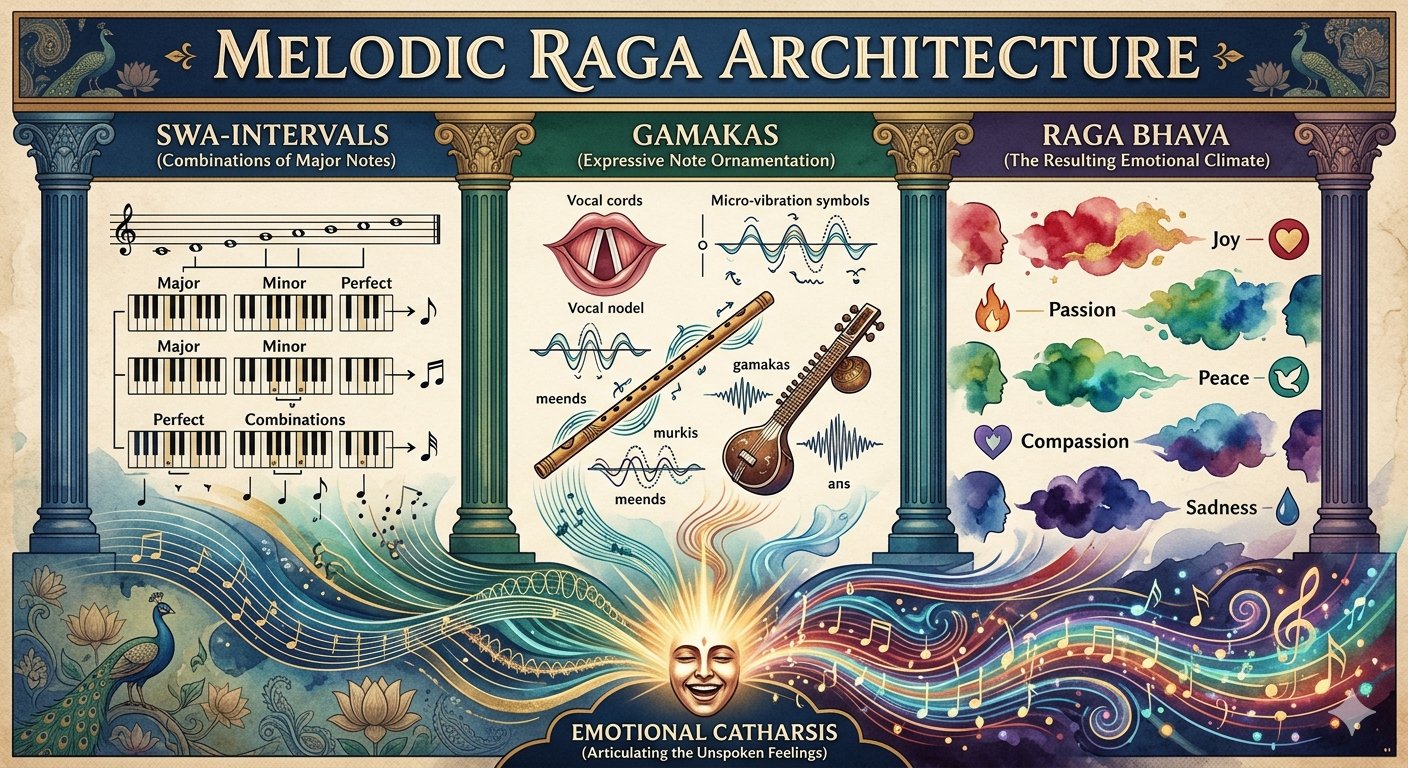
The theoretical framework of the raga finds its foundational definition in Matanga Muni’s Brihaddesi, the earliest surviving text to comprehensively outline the concept of a raga. Essential to this framework are Gamakas - the expressive ornamentation, sliding, and controlled movement of notes - which actively build the raga bhava (the distinct mood of a raga). Rishi Matanga was the historical architect who first coined and formalized the term Gamaka. Through these highly stylized musical expressions, heavy or suppressed human emotions find a safe channel for catharsis, allowing unarticulated feelings to finally be expressed.
Ultimately, Raga Chikischa invites us to witness how an external environmental sound transforms into an internal wave of emotion, awareness, and bodily alignment. Through the intertwined paths of swara, rasa, and bhava, we participate directly in an ancient aesthetic lineage. Cultivating this internal sensitivity deepens our understanding of how body, mind, and environment perpetually construct one another—allowing us to recognize the conditions that foster ease, release trapped emotions, and live more consciously within the natural rhythms of life.
*MBBS and other sources