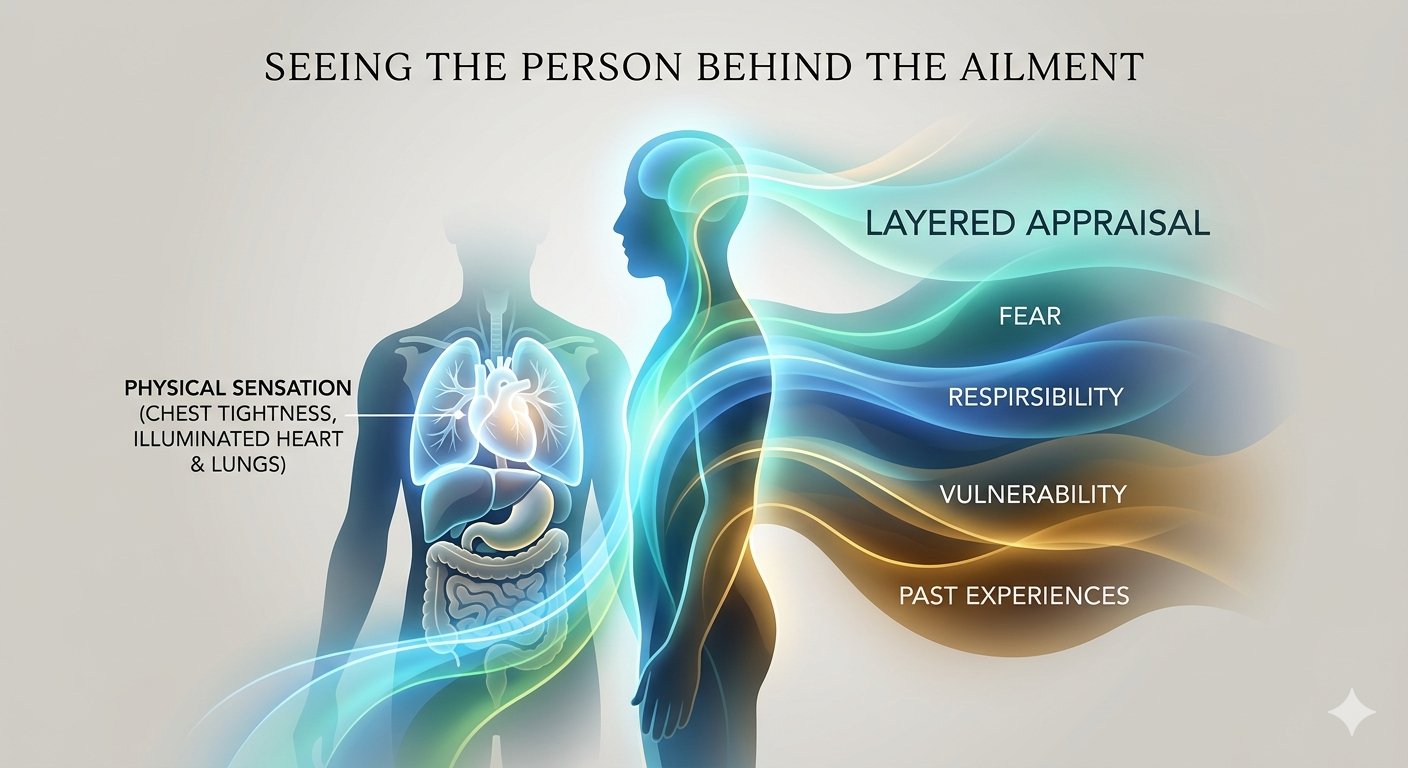
Think of the last time someone you know received difficult health news. An ailment enters a life already filled with relationships, responsibilities, memories, and expectations. It never arrives in an empty space. The meaning of this depends on the person’s life circumstances. The same diagnosis can feel very different to different people, depending on what it disrupts, what support they have, and what it comes to represent to them. And so the first question is rarely “What is it?” but “What is its meaning to the person?”
To hold this complexity gently, it helps to have a few clear words and to distinguish between disease, illness, and sickness. Each is a different window onto the same experience. Disease refers to dysfunction within the body and how it is understood clinically. Illness refers to the personal experience of suffering. Sickness refers to how a condition is recognised by society and how it affects someone’s roles and participation. Note how one person can stand at all three windows at once. These ideas overlap, but each highlights something that matters.
Imagine what this looks like ordinarily. One could be diagnosed but still not know how to explain their discomfort to family, or to keep fucntionality by adjusting to the changes. The person is still searching for words. Someone else may feel distress that is hard to put into words and worry that others will not take it seriously or more seriously than expected. You may recognise this silence in yourself or in someone close. To understand a condition, we must listen to how it is experienced in everyday life. Listening, then, becomes the first form of care.
However, no one experiences the body in isolation. Experiences that shape the body can also be shaped by social circumstances, financial pressure, unstable work life, disrupted routines, conflict with others, and limited support, all of which can accompany suffering and make care more difficult. Sometimes, the heaviest part of an ailment is everything surrounding it. In a recent fieldwork on transgenerational trauma and its impact on health, participants spoke about emotional overwhelm, recurring thoughts, communication problems, and uncertainty about where they belonged, alongside their health concerns. Their words carry a quiet message. These accounts show how people live with their experiences without claiming that one factor caused their ailments. There are many things concerning disease, illness, and sickness that require us to understand across different levels of manifestation within one individual.
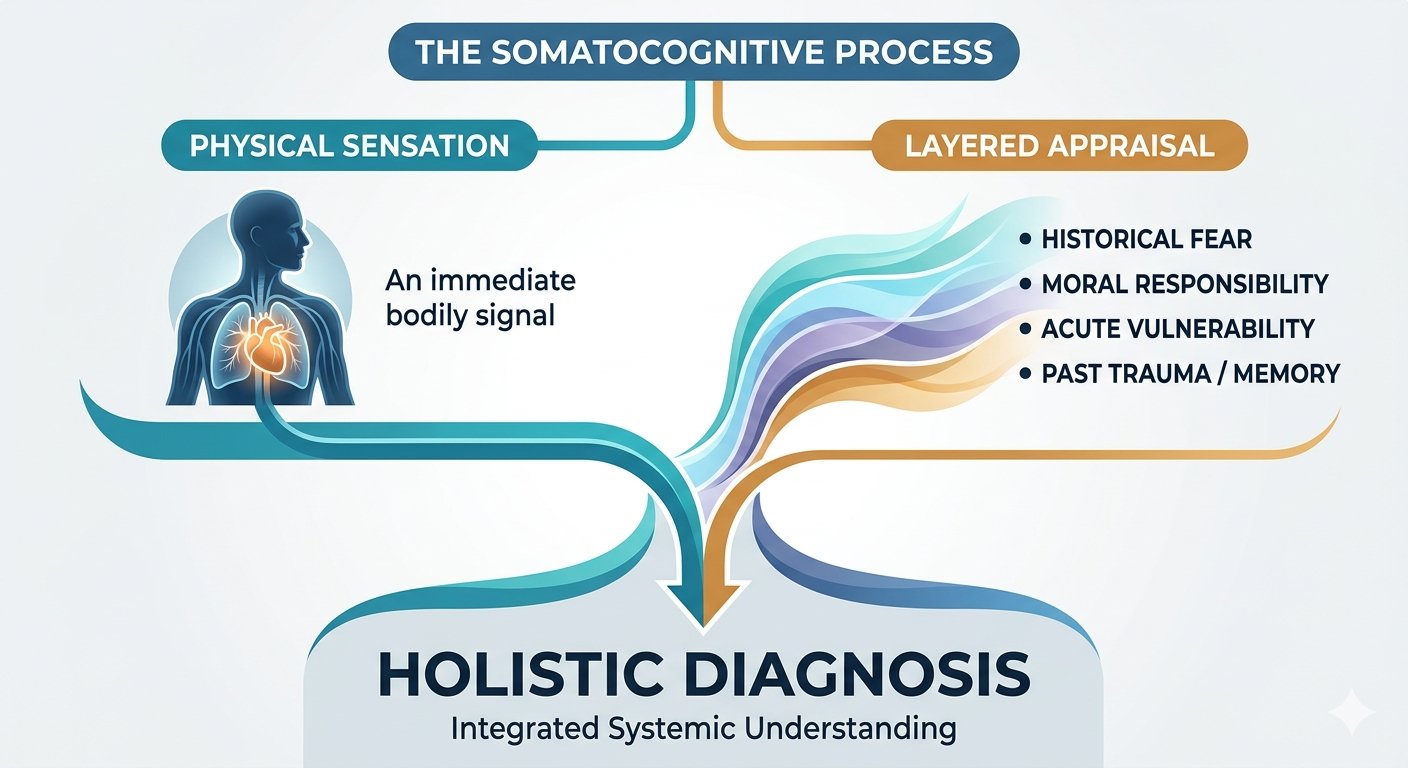
What happens when we consider the body and mind together? A somatocognitive perspective examines how bodily sensations shape attention, appraisal, and a person’s understanding of what is happening in their body. A sensation arrives, and meaning follows closely. Symptoms may be linked to fear, responsibility, vulnerability, or past experiences. The same chest tightness can mean very different things to different people. Understanding these meanings can improve care while still paying attention to the physical causes of symptoms. Both must be understood through holistic systems rather than simultaneously. not simulataneously, not in isolated bits and pieces of information based on models.
Holistic living also includes the conditions that make care possible. Time to rest, access to suitable treatment, supportive relationships, and space to communicate one’s experience are all part of the bigger picture. Each of these is a quiet support, easy to overlook until it is missing. Paying attention to someone’s surroundings can reveal practical difficulties that a diagnosis alone may not show. Sometimes, the most useful discoveries are the simplest.
If there is one thought to carry forward, it could be this one: the body belongs to a person living in a specific world. Not a case, not a file, but a life with its own setting. Care becomes more responsive when both the ailment and the world are part of the conversation. As both are heard, the conversation itself begins to heal something.
Within this conversation, something more personal often unfolds. An ailment can quietly change how someone perceives themselves. Tasks that once felt easy may require more effort, while the desire to appear well can hide how much daily life has changed for the patient. Few would see the quiet efforts of the individual to appear well, but appearing well is often a dichotomy that cannot be navigated easily by the individual. A diagnosis may bring clarity at the level of the different test parameters, connecting different signs and symptoms, but that is not the whole story. To be healed is not the same as being under treatment, as the disease is not the person; the disease is the manifestation of the imbalance of the person, whether it is external or internal. Why it creates a ruffling of our feathers is because it can also raise questions about independence and expectations of support from near and dear ones, the competence of acknowledging that yes, such and such is not okay within me, and also the future functionality of the individual. In short , uncertainty! Questions like these deserve room for deep pondering, not quick-fix answers. Even the experience of time can feel different when the body needs rest, but responsibilities keep demanding attention from the body. The way people express these difficulties is often shaped through language and expectations of their family, friends, and peers of their community. But the word is not the experience itself; it is at best a symbol or an indication( the age-old dichotomy of looking at a finger that is pointing to the moon, while the onlooker may focus on the finger or the moon). Holistic living also encompasses how one is able to handle their own ailments in a much deeper manner.
*Based on a research paper from the Centre for Neuroethnology and Consciousness Studies