Ever notice how a familiar scent can instantly transport you back to a childhood room, a specific person, or a sacred moment? For many, the warm, earthy fragrance of burning resin is a staple of memory—yet we often recognize the presence of these natural elements without truly knowing the trees they hail from or the profound insights behind their use.
Delving deeper into the flora that surrounds us expands our bond with the living landscape, indigenous communities, and ancestral traditions that have fiercely protected this knowledge over thousands of years.
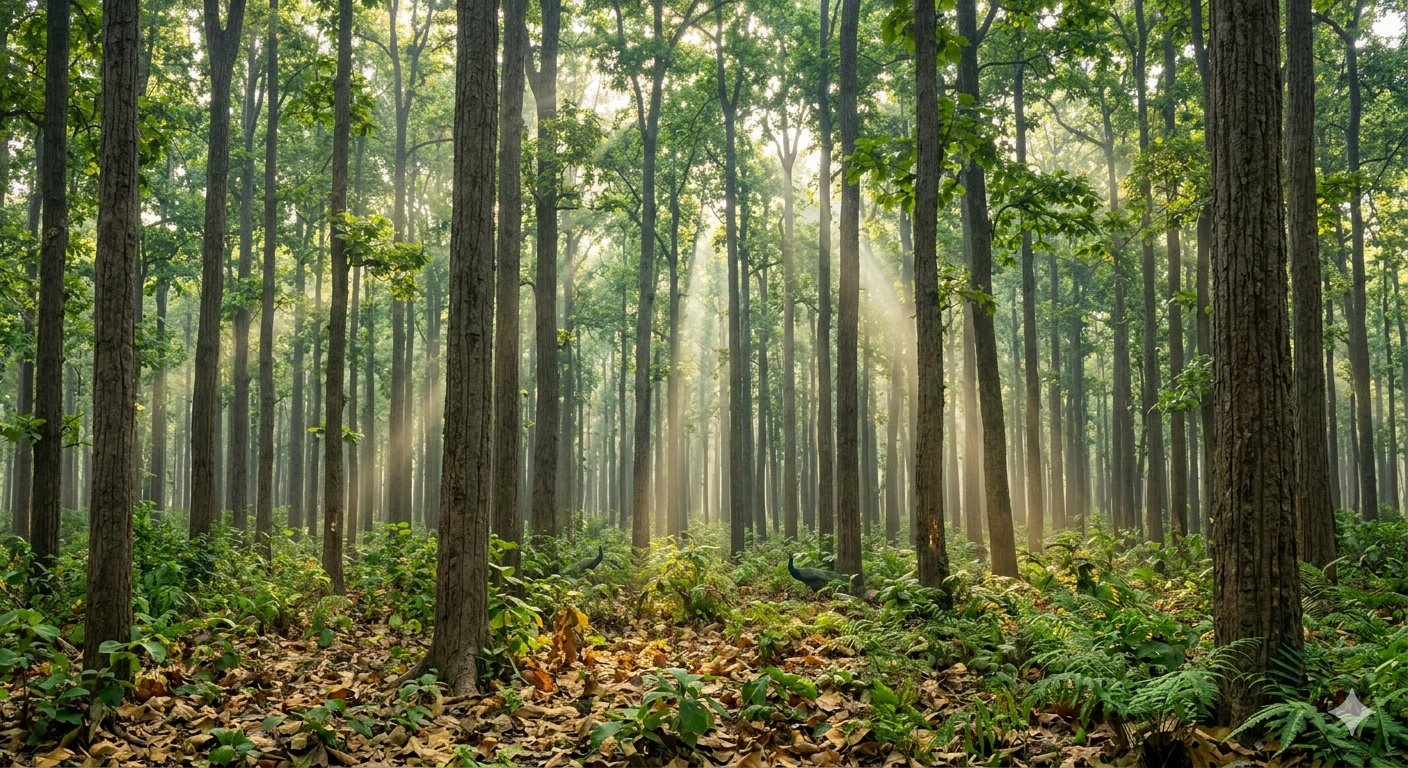
In the majestic Sal tree, this connection takes living form. It opens a quiet, aromatic doorway into the relationship between ancient wisdom and our ordinary, everyday choices.
From the protective resin that scents our homes to the timber that builds our roofs and the ancient groves we revere, the Sal tree intertwines with our existence. Learning its story brings us closer to an inheritance we may have lived with long before we ever learned its botanical name.
The Science of Jhuna: Nature’s Protective Exudate
The solidified oleoresin collected from Sal trees is known colloquially as Jhuna. Commonly sprinkled over glowing charcoal, its fragrant smoke has been utilized as a natural insect repellent and ritual air purifier for millennia.
But what is this resin to the tree itself?
In the language of traditional pharmacology, it is rala niryasa—a defensive exudate released from injuries to the trunk to heal the bark and lock out invading insects. Because this protective fluid spreads an incredibly pleasant, grounding aroma upon burning, ancient Indic wisdom lineages elegantly named it Sooradhoopa or Yakshadhoopa (the incense of the divine spirits).
From Traditional Ethnomedicine to the Lab
Within Indian ethnomedicine, the profound depth of the Sal tree’s properties spans multiple classical systems. Siddha medicine utilizes this resin under the name kungiliyam to practice Yegha Mooligai Prayogam—the sophisticated principle of deploying a single therapeutic herb to address complex bodily imbalances. It is traditionally prescribed to treat menorrhagia and leucorrhoea, dysentery, he active healing of open wounds, deep cuts, and skin burns. Foundational texts like the Charaka Samhita, Sushruta Samhita, and Dhanwantari Nighantu meticulously document the tree’s capability in knitting together bone fractures, neutralizing internal and external toxins, cleansing stagnant wounds or painful boils, and subduing severe skin itching
In the Ganjam and Kandhamal regions of Odisha, local communities preserve highly practical home remedies using pure jhuna. It is ground into a fine powder, mixed into warm cow's milk, and ingested to swiftly relieve severe physical pain. Inhaling or exposing the skin to warm jhuna vapors is used to deeply relax the nervous system, reduce itching, and assist the skin in renewing itself following bouts of chickenpox.
Modern pharmacological evaluation is catching up to these ancient applications, with emerging studies actively exploring the resin's lipid-lowering, anticancer, and immunomodulatory properties. When mixed with raw beeswax, it safely remedies cracked feet and burns; when blended with pure cow’s ghee, it serves to relieve painful hemorrhoids.
For the Munda, Kurukh, Dongria, and Oraon peoples of the subcontinent, the Sal tree (Shorea robusta) is nothing short of a divine anchor. Every auspicious life event and tribal ritual requires the lighting of its oleoresin. These communities maintain pristine, undisturbed patches of old-growth forest known as sacred groves, where they directly revere Sarna Budhi—the sacred woman and protective spirit of the holy woods.
Our persistent modern attraction to this wondrous tree and the scent of its burning resin is perhaps an epigenetic memory, a preserved polysemy embedded in our consciousness that continually draws us back to our ecological roots.
In Sanskrit, the Sal tree is called Shala, a word that literally translates to “house.”
A house represents the physical structure in which we take shelter, but it also symbolizes the physical body that houses our interacting, conscious self.
Think about the architecture of a home: we live inside our bodies and within our rooms, but we also simultaneously share a much larger, interconnected global space with all living organisms. How we choose to care for each part of this structure—from the air inside our rooms to the soil outside our gates—reflects our overall approach to living in the world.
Discovering the living, breathing forest source behind a familiar household scent adds an intentional layer to our everyday existence. It highlights how our immediate physical needs, our cultural habits, and the realities of the natural world are constantly meeting in our daily lives. Living holistically means recognizing these invisible connections and taking active responsibility for them—cherishing the ancestral knowledge passed down to us, utilizing it safely, and fiercely protecting the fragile ecosystems that make its nourishment possible.
*PS